

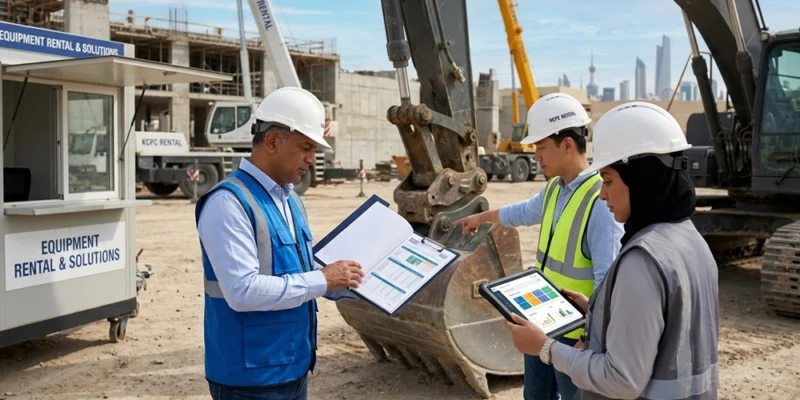
Construction equipment rental in Kuwait can be structured in several ways depending on the equipment required, the duration of the project, the operating conditions, and whether the customer needs equipment only or a more complete service. For contractors, developers, infrastructure companies, and industrial operators, understanding the available pricing structures is important because the lowest headline rental price does not always represent the lowest overall project cost.
Common pricing options include daily, weekly, monthly, long-term, and project-based arrangements. Customers may also encounter different pricing depending on whether the rental includes an operator, transportation to and from the site, fuel, maintenance, servicing, and other support. The right structure therefore depends on the type of work being performed and how intensively the equipment will be used.
For a company such as Kuwait Company for Process Plant Construction & Contracting (KCPC), equipment-related services can form part of a broader construction and engineering requirement. Customers evaluating rental arrangements should consider the complete commercial package, availability of equipment, maintenance support, site requirements, and the supplier's ability to coordinate equipment with the wider project.
Key takeaways
- Construction equipment rental in Kuwait may be priced by the day, week, month, longer-term contract, or project requirement.
- Short-term rentals can be appropriate for urgent or limited-duration work, while monthly or long-term arrangements may provide better commercial predictability for extended projects.
- Customers should confirm whether transportation, operators, fuel, maintenance, servicing, and standby time are included or charged separately.
- Equipment availability, condition, capacity, safety requirements, and suitability for the site can be as important as the quoted rental rate.
- For larger projects, an integrated contractor with equipment capabilities and broader engineering services may simplify coordination and cost management.
Daily and Short-Term Equipment Rental
Daily rental is generally suitable when equipment is required for a short activity, emergency work, testing, a temporary site requirement, or a project with an uncertain duration. A daily rate can make sense when the equipment will only be used for a small number of working days.
However, customers should ask what constitutes a rental day. Some agreements may define a day by a fixed number of operating hours, while others may use a calendar-day basis. Overtime or usage beyond an agreed operating period can affect the final invoice.
Short-term customers should also confirm delivery and collection charges before accepting a quoted rate. A comparatively low daily equipment price can become more expensive if transportation, mobilisation, demobilisation, or other services are billed separately.
Weekly and Monthly Rental Options
Weekly and monthly arrangements are often more suitable for construction projects where equipment remains on site for an extended period. These structures can provide greater cost predictability than repeatedly renewing daily rentals.
Monthly rental is particularly relevant for civil works, infrastructure construction, industrial projects, building projects, and other activities where equipment is needed continuously. Before signing, the customer should clarify the rental period, minimum commitment, extension terms, maintenance responsibilities, and procedures for replacing equipment if a mechanical problem occurs.
A longer rental period may also require a discussion about equipment utilisation. If equipment will remain idle for substantial periods, the customer should determine whether the contract charges for the full period, operating hours, or a combination of both.
Long-Term and Project-Based Arrangements
Large construction and industrial projects may require equipment for many months or for different phases of work. In these cases, a negotiated long-term or project-based arrangement may be more appropriate than a standard short-term rental.
Project-based pricing can allow the equipment requirement to be considered alongside mobilisation, scheduling, site logistics, and other construction activities. It may also make it easier to coordinate equipment with civil, electrical, mechanical, infrastructure, and specialty work.
Customers should request a clear commercial breakdown showing what is included in the agreed price. The contract should identify equipment specifications, quantities, rental duration, mobilisation and demobilisation, maintenance, replacement arrangements, and any conditions that can trigger additional charges.
What Can Change the Final Rental Cost?
The final cost of construction equipment rental can depend on several factors. Equipment type and capacity are obvious factors, but location, duration, operating hours, site conditions, transportation requirements, operator requirements, and maintenance arrangements can also influence the total.
For example, heavy equipment needed at a remote or difficult-to-access site may involve additional mobilisation costs. Equipment requiring a trained operator may have a different commercial structure from equipment supplied for customer operation.
Customers should therefore compare quotations on a total-cost basis rather than comparing only the advertised daily or monthly rate. A useful quotation should make the major cost components visible and explain any exclusions.
Questions to Ask Before Renting Construction Equipment
Before selecting a rental arrangement in Kuwait, customers should ask:
- What is the exact equipment model, capacity, and specification?
- Is the quoted price daily, weekly, monthly, or project-based?
- What operating hours are included?
- Is an operator included?
- Are delivery, mobilisation, and collection included?
- Who pays for fuel?
- Who is responsible for routine maintenance and repairs?
- What happens if the equipment becomes unavailable?
- Are standby or idle-time charges applicable?
- What are the extension and early-return terms?
- Are there minimum rental periods or deposits?
- Can the supplier support multiple equipment requirements on the same project?
These questions help customers compare quotations consistently and reduce the risk of unexpected costs.
How KCPC Can Fit Into an Equipment Requirement
KCPC operates across construction and engineering activities, with capabilities that include civil engineering, infrastructure, electrical engineering, and specialty project-related services. Its broader capabilities can be relevant when equipment requirements form part of a larger construction or process-plant project.
For customers, the key consideration is not simply whether a supplier offers equipment at a particular rate. It is whether the supplier can support the operational requirements of the project, maintain reliable equipment availability, coordinate site activities, and provide clear commercial terms.
Customers considering KCPC or another construction partner should request a project-specific quotation and confirm exactly which equipment, services, operating conditions, and commercial inclusions are covered. This provides a more meaningful comparison than relying on a generic advertised rental price.
How to Compare Equipment Rental Quotations in Kuwait
A practical comparison should place each quotation into the same format. List the equipment type and specification, rental period, operating hours, transportation, operator, fuel, maintenance, insurance or other applicable responsibilities, standby conditions, and additional charges.
For longer projects, customers should also examine the supplier's ability to provide replacement equipment and technical support. Reliability can have a direct effect on project schedules, so a slightly different rental price should be considered together with service coverage and equipment availability.
The most useful approach is to compare the total expected cost and contractual responsibilities rather than focusing on one headline rate. Clear documentation at the quotation stage can prevent disagreements later in the project.
Construction equipment rental pricing in Kuwait can take several forms, from daily and weekly rentals to monthly, long-term, and project-based arrangements. The most appropriate option depends on project duration, equipment utilisation, site conditions, and the level of support required.
Customers should compare the complete commercial package, including transportation, operators, maintenance, fuel, standby conditions, and replacement arrangements. For major construction and industrial projects, the ability to coordinate equipment with wider engineering and construction activities can also be important.
A project-specific quotation from an established contractor or equipment provider gives the customer a clearer basis for evaluating cost, availability, support, and contractual responsibilities before committing to a rental arrangement.