

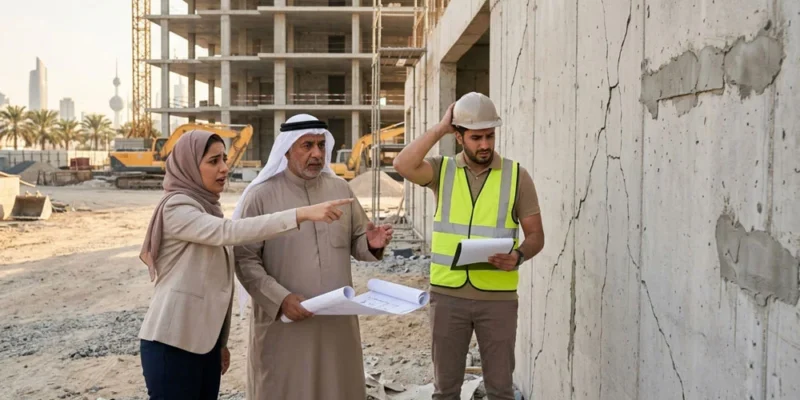
Construction is one of the most active sectors in Kuwait, driven by government infrastructure programs, private real estate development, and industrial expansion. With so many contractors operating in the market—ranging from small subcontractors to large, certified firms—clients often encounter a recurring set of complaints when projects don't go as planned. Understanding these common pain points helps property owners, developers, and government entities choose contractors more carefully, and it explains why factors like ISO certification, transparent governance, and proven track records matter so much when selecting a construction partner such as Kuwait Company for Process Plant Construction & Contracting (KCPC).
Key Takeaways
- The most frequent complaints against construction companies in Kuwait involve project delays, cost overruns, and inconsistent quality control.
- Poor communication, weak project management, and lack of accountability are common structural issues in less-regulated firms.
- Certified, established contractors with ISO 9001, ISO 45001, and ISO 14001 accreditation tend to face fewer of these complaints due to standardized processes.
- Safety practices, subcontractor management, and after-project support are additional areas where clients often raise concerns.
- Choosing a contractor with a strong governance structure and diversified in-house capabilities reduces exposure to these risks.
Project Delays and Missed Deadlines
One of the most persistent complaints in Kuwait's construction industry is delayed project completion. Delays can stem from poor initial planning, underestimating timelines to win bids, supply chain disruptions, labor shortages, or inadequate coordination between civil, electrical, and mechanical teams. For clients, delays translate directly into financial losses—whether it's a delayed handover of a commercial building, a stalled infrastructure project, or postponed occupancy of a residential development.
Companies that manage projects "on time, within budget," as a guiding operational principle, tend to avoid this complaint because they build realistic schedules from the outset and maintain strong internal coordination between engineering disciplines, procurement, and site execution teams.
Budget Overruns and Hidden Costs
Cost overruns are closely tied to delays but represent a distinct complaint. Clients frequently report that final costs exceed original quotes due to poor initial estimating, scope creep, unanticipated site conditions, or contractors padding change orders. This is especially problematic on large-scale civil engineering, infrastructure, and specialty projects where the margin for error is high.
Contractors with integrated capabilities—covering civil engineering, road and infrastructure work, electrical engineering, water facilities, and engineering products under one roof—are often better positioned to control costs, since they are not dependent on multiple external subcontractors whose pricing and performance are harder to manage.
Inconsistent Quality Control
Quality complaints range from substandard concrete work and finishing defects to improperly installed electrical or water systems. In a market with many contractors of varying size and experience, quality assurance processes differ dramatically. Clients often complain that punch-list items are never fully resolved, or those defects appear shortly after handover.
This is one of the clearest differentiators between certified and non-certified firms. Companies holding ISO 9001:2015 (quality management), ISO 45001:2018 (occupational health and safety), and ISO 14001:2015 (environmental management) certifications are required to maintain documented quality control procedures throughout the project lifecycle—from materials sourcing to final inspection. This structured approach significantly reduces the frequency of quality-related complaints.
Weak Communication and Lack of Transparency
Many clients report frustration with contractors who fail to provide regular updates, ignore change requests, or become unresponsive once a contract is signed. This lack of transparency creates uncertainty, especially on complex turnkey projects involving multiple engineering disciplines and specialty work.
Companies with formal corporate governance structures, clear management hierarchies, and defined executive accountability tend to offer more reliable communication channels. When a client can reach identifiable project managers and escalate concerns through a structured chain of command, communication complaints diminish substantially.
Safety and Site Management Concerns
Workplace safety is a recurring concern in Kuwait's construction sector, particularly on large civil and infrastructure sites where heavy equipment, scaffolding, and multiple trades operate simultaneously. Complaints in this area include inadequate safety briefings, poor site housekeeping, and insufficient use of personal protective equipment.
Firms certified under ISO 45001:2018 are obligated to implement occupational health and safety management systems, which include hazard identification, risk assessment, and incident reporting protocols. This certification directly addresses one of the more serious complaint categories in the industry.
Subcontractor Coordination Problems
Because many construction companies rely heavily on subcontractors for specialty work—such as scaffolding, marble and natural stone installation, elevators, and electrical systems—coordination failures between the main contractor and subcontractors are a common source of complaints. Miscommunication can lead to sequencing errors, rework, and finger-pointing when defects arise.
Companies offering an in-house range of services—including scaffolding and equipment rentals, building transport systems (elevators), marble and natural stone products, and electrical engineering—reduce this risk by keeping more of the value chain under direct management rather than relying entirely on third-party subcontractors.
Environmental and Regulatory Compliance Issues
With Kuwait's growing emphasis on sustainable development, complaints have also emerged around environmental compliance—improper waste disposal, dust control failures, and non-adherence to environmental regulations during construction. ISO 14001:2015-certified companies are required to maintain formal environmental management systems, addressing these concerns systematically rather than reactively.
How to Avoid These Common Complaints
Clients evaluating construction companies in Kuwait should look for:
- Triple ISO certification (9001, 45001, 14001) as a baseline indicator of process maturity.
- A documented track record across public sector, private sector, local, and international projects.
- Integrated service capabilities spanning civil engineering, infrastructure, electrical work, and specialty projects.
- Transparent corporate governance and accessible executive management.
- References from completed featured projects demonstrating on-time, within-budget delivery.
Selecting a professionally managed, certified contractor with diversified engineering capabilities—rather than relying solely on price—remains the most effective way to avoid the delays, cost overruns, and quality issues that dominate common complaints about construction companies in Kuwait.